Residential Proxies Benefits and Usage Explained
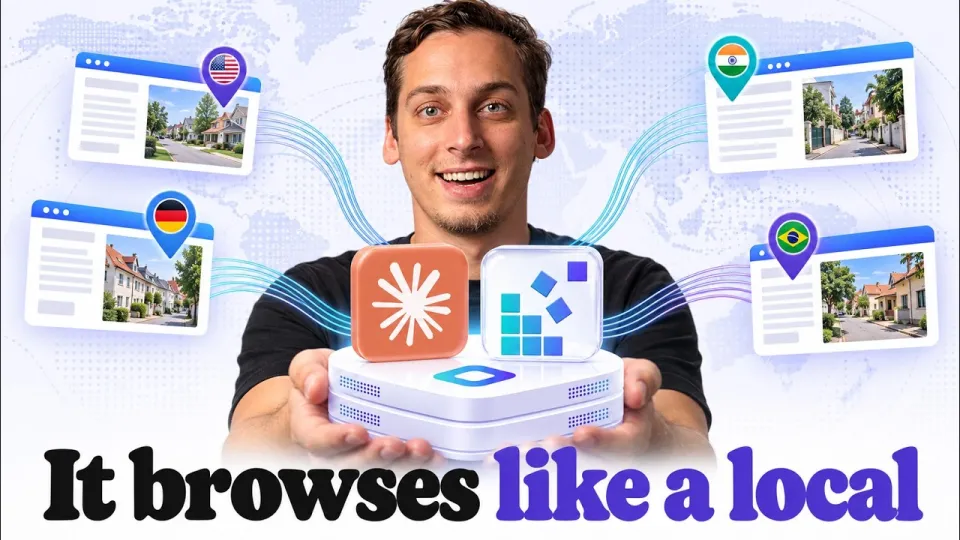
Video: This Claude Code Agent Uses Residential Proxies to Find Hidden Prices
· based on the channel Lukas Margerie
Residential proxies are specialized proxy servers that route internet requests through real home internet connections rather than data center IPs, making them appear as genuine local users in targeted countries. They are essential tools for businesses and developers who need to perform web scraping, price comparison, geo-targeting, and bypass geographic restrictions without being flagged or blocked.
What Are Residential Proxies
Residential proxies assign IP addresses from actual residential ISPs. Unlike VPNs or data center proxies, which use centralized servers often identifiable and blocked by websites, residential proxies make traffic appear as if it originates from a real home user. This authenticity allows users to access geographically restricted content or localized pricing.
Key features include:
- IPs tied to physical locations and ISPs.
- Difficult to detect or blacklist by websites.
- Ideal for accessing region-specific content.
How Residential Proxies Work
Each request sent through a residential proxy uses an IP address assigned to a real household internet connection. When you select a country, the proxy routes your traffic through an ISP in that country, letting websites believe you are a local user. Rotating residential proxies refresh the IP address with every new connection, improving anonymity and reducing blocking risk.
For example, in the use case described by Lukas Margerie, residential proxies from the US, Germany, Brazil, and India were used to access pricing pages for services like Spotify and Canva, revealing significant regional price differences.
Residential Proxies vs VPNs
VPNs route all your internet traffic through a single centralized server, typically located in a data center. This makes VPN IPs easier for websites to detect and block since many users share the same IPs. Residential proxies, on the other hand, use diverse IPs from real home networks, making them less suspicious and more effective for tasks like web scraping or price monitoring.
Summary of differences:
- VPN: Single server IP, easier to detect.
- Residential Proxy: Multiple real ISP IPs, hard to detect.
Use Cases of Residential Proxies
- Web Scraping: Extracting data from websites without getting blocked. Residential proxies help by rotating IPs and mimicking real users.
- Price Comparison: Accessing localized pricing for SaaS, streaming, or e-commerce platforms by simulating users from different countries.
- Geo-Targeting: Testing and verifying how websites behave or display content in multiple regions.
- Ad Verification: Ensuring ads appear correctly in targeted locations.
In the example from Lukas Margerie’s video, residential proxies enabled an AI agent built with Claude Code and Playwright to automatically scrape pricing pages from multiple countries and aggregate the data into a comparative report.
Rotating Residential Proxies Explained
Rotating proxies assign a fresh IP address from the residential pool with every new connection or request. This rotation enhances privacy and prevents websites from flagging repeated access from the same IP, which is crucial for large-scale scraping or monitoring operations.
Features:
- Continuous IP refresh.
- Lower chance of IP bans.
- Supports high-volume automated tasks.
Regional Pricing Insights Using Residential Proxies
Many SaaS and subscription services adjust their prices based on the user’s location. For instance, Spotify Premium costs about $12.99/month in the US but roughly $1.45/month in India. Canva Pro’s annual subscription varies from $144 in one country to $42 in another. Residential proxies reveal these hidden price discrepancies by allowing users to access pricing pages as local customers.
Businesses can leverage this data for competitive analysis, market research, and to tailor their own pricing strategies.
Typical Questions About Residential Proxies
Some common concerns include:
- Are residential proxies legal? Generally yes, but users must comply with website terms of service.
- How reliable are residential proxies? They provide higher reliability and lower blocking risk compared to data center proxies.
- Are they expensive? Residential proxies tend to cost more due to their authenticity and complexity.
Useful Links
- DataImpulse residential proxies for web scraping and geo-targeting: https://dataimpulse.com/?utm_source=youtube&utm_medium=video&utm_campaign=lukasmargerie
- Claude Code AI agent used for scraping: https://www.claude.com/product/claude-code
- Playwright automation framework: https://playwright.dev
Итог
Residential proxies provide a powerful, reliable way to access localized content, perform web scraping, and uncover hidden regional pricing. Their use of real ISP IPs and rotating functionality makes them superior to VPNs and data center proxies for these tasks. The example from Lukas Margerie’s channel showcases how residential proxies combined with AI and automation tools simplify complex data collection across multiple countries. For those looking to explore residential proxies, DataImpulse offers a robust network to get started.
Key takeaways
- Residential proxies use real home ISP IPs to appear as local users.
- They enable geo-targeting by routing requests through chosen countries.
- Rotating residential proxies provide fresh IPs on each connection.
- They help uncover regional pricing differences in SaaS and streaming services.
- Residential proxies reduce the risk of blocking compared to VPNs or data center IPs.
Source: This Claude Code Agent Uses Residential Proxies to Find Hidden Prices · Markdown version
Questions & answers
What is the difference between a VPN and a residential proxy?
A VPN routes all your traffic through a single server, usually from a data center, which can be detected and blocked by websites. A residential proxy uses IPs from real home internet connections, making requests appear as if they come from genuine local users, reducing the chance of detection.
Why are residential proxies better for web scraping?
Residential proxies provide rotating, real ISP IP addresses that mimic genuine user behavior, making it harder for websites to detect automated scraping and block the IPs. This allows for more reliable and extensive data collection.
How do residential proxies help reveal hidden prices?
By routing requests through IPs located in different countries, residential proxies let users access the localized versions of pricing pages. This reveals regional price variations that are otherwise hidden when accessing from a single location.
Are residential proxies legal to use for price comparison?
Generally, using residential proxies is legal, but users should ensure they comply with the terms of service of the websites they access. Residential proxies enable ethical market research and competitive analysis when used responsibly.